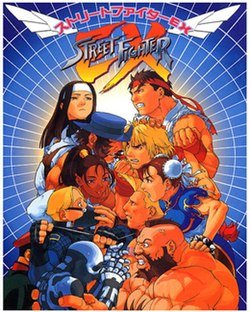


Capcom History ha pubblicato delle immagini nell'album Licensed riguardante Street Fighter EX Plus Alpha
Fonti: Wikipedia ITA/ENG
La trama di Street Fighter EX Plus (e della serie EX in generale) espande l'universo di Street Fighter con nuovi personaggi e sottotrame, concentrandosi su misteri legati all'organizzazione Shadaloo, poteri psichici, e le motivazioni personali dei lottatori, con personaggi come Pullum Purna che cerca il suo padre perduto, collegandosi a Shadaloo, mentre Kairi (della famiglia Mizugami) e altri esplorano le proprie origini e il destino, il tutto in un contesto 3D che introduce elementi nuovi e connessioni con la lore principale, specialmente dopo gli eventi di SFII e la resurrezione di Bison.
(PLACEHOLDER IA perché non ho trovato altro)
Street Fighter EX (ストリートファイターEX?, Sutorīto Faitā EX) è un videogioco arcade sviluppato da Arika e pubblicato nel 1996 da Capcom.
Si tratta di uno spin-off della serie Street Fighter, e il primo della serie ad avere grafica 3D.
Del videogioco è stata realizzata una conversione per PlayStation dal titolo Street Fighter EX Plus α.
Il picchiaduro presenta un sistema di gioco simile a quello di Street Fighter II e Street Fighter Alpha. Nella versione cabinato compaiono 17 personaggi.
It is a spin-off of the Street Fighter series co-produced by Capcom with Arika and was the first game in the series to feature 3D polygon graphics, although it retains the 2D plane gameplay.
Development of the game was headed by Akira Nishitani, best known for his work on Street Fighter II.
Though the gaming media had widely perceived Capcom's first in-house polygonal fighting game, Star Gladiator, as a warm-up for their first polygonal Street Fighter game, Arika did not consult with the Star Gladiator team in making Street Fighter EX.
Arika vice president Ichiro Mihara explained, "In specific terms, it's a different development line.
In addition, technically, it's completely different.
The know-how we're using for this 2D/3D fighting game has no relation to Star Gladiator.
Fundamentally, Arika is not a subsidiary company of Capcom. ...
Some people may be under the impression that as we came from Capcom, there's some sort of link between us but in reality it's a different team making a different game.
The concept is new and the know-how is new."
A Nintendo 64 port was also announced for release in 1997, but later cancelled.
The music was written by former Namco composers, Takayuki Aihara, Shinji Hosoe, and Ayako Saso.