


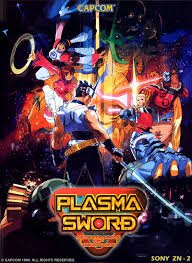
Capcom History ha pubblicato delle immagini nell'album La storia di Capcom (1984 ad oggi) riguardante Plasma Sword: Nightmare of Bilstein
Fonti: Wikipedia ITA/ENG
In the epic battle of the Final Crusade that had occurred last year, Hayato Kanzaki slew the evil Dr. Edward Bilstein; bringing an end to the Fourth Empire's terror and destruction and signalling the restoration of peace and happiness.
Rumors have been circulating about the return of Bilstein in a new cybernetic body, as well as the appearance of a ghost who eerily looks like Bilstein's old cybernetic body.
The Fourth Empire has rebuilt its forces and are determined to carry out Bilstein's will of universal conquest.
Hayato, June, Saturn, and Gamof reenter the fight to defeat Bilstein and the Fourth Empire. They have new friends to assist them, such as their former enemy Zelkin, an extremely strong Japanese military war soldier named Gantetsu, a noble and aspiring young American modern-day superhero with a bird motif named Eagle, and a mysterious yet cheerful young Japanese rhythmic gymnast named Ele.
Star Gladiators, Fourth Empire members, and neutral parties are thrust into a war to determine the fate of not only the Earth, but of the entire universe.
Plasma Sword: Nightmare of Bilstein (スターグラディエイター2?, Sutāguradieitā Tsū, Star Gladiator 2) è un videogioco arcade pubblicato da Capcom nel 1998.
Convertito successivamente per Dreamcast, il gioco è il seguito di Star Gladiator.
The game reworks and improves elements from Star Gladiator, such as the control system and gameplay mechanics, while adding new concepts such as the Plasma Field;
a type of special move that traps the opponent when hit and activates a different effect depending on the character selected.
The control system from the first Star Gladiator was reworked and rebuilt for the sequel. Much like the first game, players are given an arsenal of four usable buttons.
Two of the buttons are attacks for a fighter's weapon while one button is used for a kick attack and the final button is used for inward and outward sidesteps as well as dashes.
The Plasma Combo System was discarded in favor of the Plasma Strike System, in which all characters have a Plasma Gauge (similar to the ones found in Street Fighter and Darkstalkers) and that they can store up to three levels of the Plasma Gauge, enabling them to pull off super moves called Plasma Strikes.
Unlike the first game, fighters are able to battle on an endless 3D plane field, meaning that ring-outs were unavailable from within sight.
Like other 3D fighting games, set combos were implemented through tapping a specific sequence of buttons.
However, characters could perform special moves from within the combos themselves, akin to 2D fighting games (similar to the treatment found in the Street Fighter EX series).
Characters can also counter incoming attacks using a Plasma Reflect or Plasma Revenge tactic against their opponent, requiring at least half of a Plasma Gauge level.
One new tactic introduced from within Plasma Sword is that characters were granted a unique special skill called a Plasma Field.
With the use of one level from the Plasma Gauge, the character who activates it will emit a sphere of Plasma energy around them. If the opposing character is hit by it, the 3D plane field will be temporarily boxed in with four invisible walls, making escape from the Plasma Field quite difficult.
The effects of the Plasma Field vary with each character, ranging from infinite Plasma Strikes, growing to gigantic sizes, and even stopping time.
Directors:
Yoichiro Ikeda
Takayoshi Terada
Producers:
Noritaka Funamizu
Koji Nakajima
Artist:
Bengus
Composers:
Tetsuya Shibata
Takayuki Iwai
Capcom History
A quanto pare Itsuno non ha lavorato al progetto
Capcom History
Purtroppo non sono riuscito a trovare una foto del Cabinato